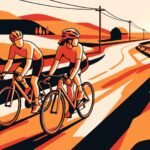


A time trial is a cycling race against the clock. Instead of starting together in a large peloton, riders usually start individually at set intervals and try to complete the course as quickly as possible. Time trials reward sustained power, aerodynamic efficiency, pacing and concentration.
How a time trial works
In an individual time trial (ITT), riders start one by one, often separated by a fixed interval. The rider with the fastest time over the course wins, subject to the event’s rules and any penalties. Because competitors do not start together, the first rider across the finish line is not necessarily the fastest overall. The official times determine the result.
Time trials can be short and explosive or long tests of endurance. In stage races such as the Giro d’Italia, Tour de France and Vuelta a España, an ITT can create important time gaps between general-classification contenders.
Individual and team time trials
The two main formats are individual time trials and team time trials (TTTs). Both are raced against the clock, but the tactics and scoring can differ according to the event regulations.
- Individual time trial: each rider races the course alone against the clock. Drafting behind another competitor is generally prohibited, subject to the rules and required passing distances.
- Team time trial: a group of teammates rides together and shares the work at the front. Riders rotate to help maintain speed, while the team’s time is recorded according to the specific event’s rules.
Team time trials test coordination as well as fitness. Riders need to communicate, rotate smoothly and manage their efforts so the group can keep moving efficiently without leaving key teammates behind too early.
Time-trial bikes
Time-trial bikes are designed to reduce aerodynamic drag and help riders maintain an efficient position at high speed. They may feature aerodynamic frames, deep-section wheels, aero extensions and integrated equipment. Riders also use tight-fitting clothing and carefully positioned helmets where the regulations permit.
The equipment must comply with the rules of the relevant governing body and event. Specialist time-trial bikes are designed for timed events, while mass-start road races generally require road-racing equipment that meets the applicable rules. A more aerodynamic setup is not automatically faster for every rider or course: handling, comfort, terrain, wind and the rider’s ability to sustain the position all matter.
Pacing
Going flat out from the start can cause a rider to fade badly later. Effective pacing means choosing an effort that can be sustained over the course, while adapting to climbs, descents, corners and wind direction. Riders often use power data, heart rate, perceived effort and course knowledge to guide their performance. Power matters, but aerodynamics, position, handling and the ability to stay focused also influence the final time.
- Start controlled: accelerate smoothly instead of wasting energy in an unsustainable opening effort.
- Stay aerodynamic: maintain a stable position when safe and practical, without compromising control.
- Manage climbs: adjust effort to the gradient and avoid unnecessary surges.
- Use corners wisely: prioritise safe lines and smooth acceleration rather than taking risks.
- Finish strongly: use the remaining energy for the final section when the course and effort allow it.
There is no single pacing formula for every time trial. Course length, elevation, weather, rider fitness and the importance of the event all influence the best strategy.
Time trials and the general classification
In a stage race, an individual time trial can be decisive because each rider’s time contributes to the overall standings. A strong time-trial specialist may gain time on a climber on flatter terrain, while a climbing-heavy course can favour riders who combine efficient pacing with uphill strength. The actual result depends on the route and the riders’ abilities.
For a beginner-friendly explanation of cumulative race time, read our guide to general classification (GC) in cycling. You can also read our comparison of the Giro d’Italia, Tour de France and Vuelta a España to see how time trials fit into the three Grand Tours.
Time trial and road race compared
In a typical mass-start road race, riders start together and can use drafting, attacks and team tactics throughout the event. In an individual time trial, riders start separately and aim for the fastest time under rules that generally restrict drafting. Those rules specify the distances and procedures riders must follow when approaching or passing another competitor. Both formats require endurance, but they reward different tactical skills.
Our guide to the UCI WorldTour, teams and rankings gives more context on the professional racing calendar and how teams compete.
Editorial note: time-trial procedures, drafting distances, equipment standards and team-time-trial scoring can vary by event. Consult the current regulations for the race you are following.