

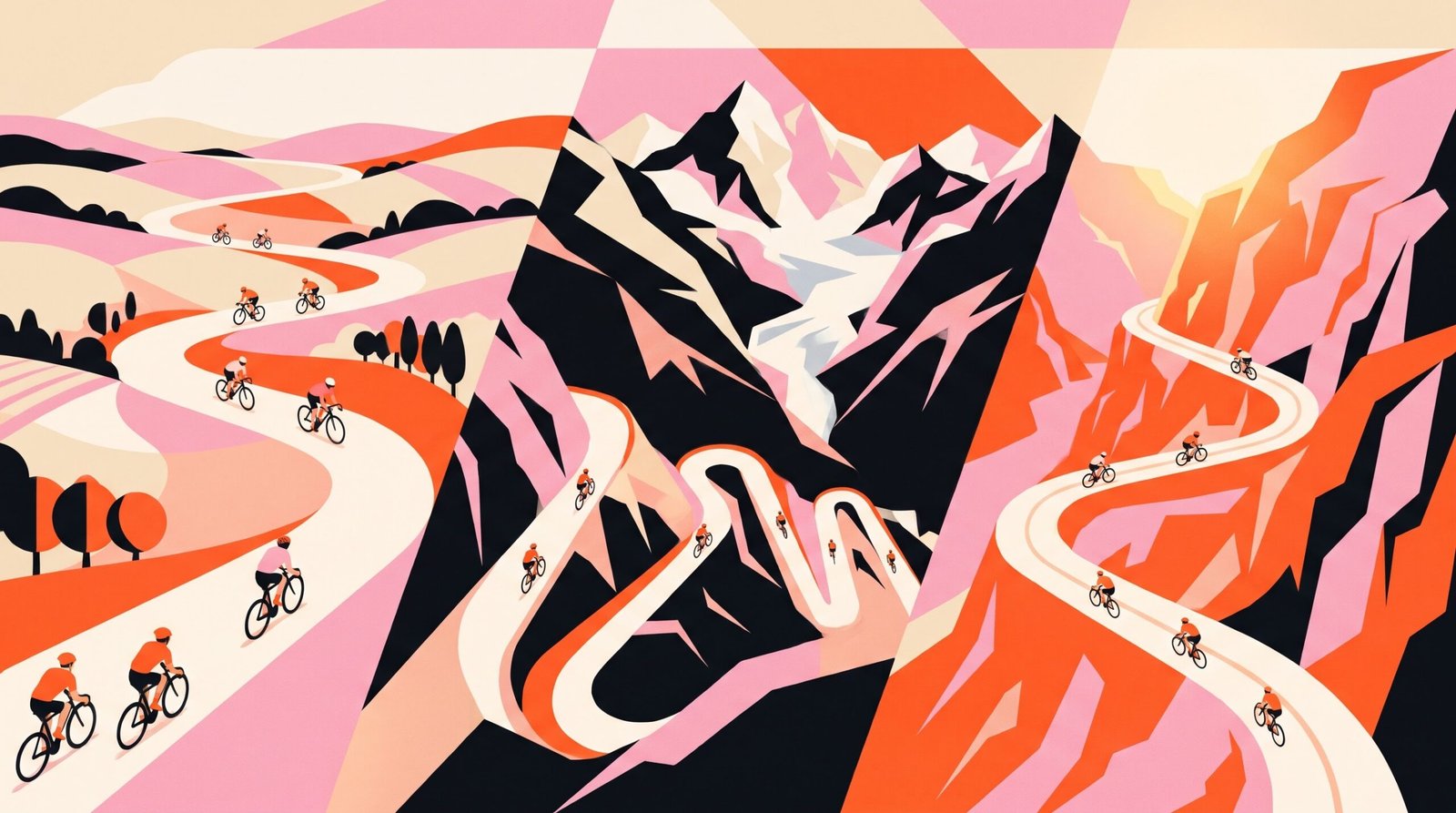
The Giro d’Italia, Tour de France and Vuelta a España are the three Grand Tours of men’s professional road cycling. Each is a multi-week test of endurance, climbing, time-trialling, teamwork and recovery. They share the same aim, to win the general classification, but each race has its own traditions and challenges.
What a Grand Tour is
A Grand Tour is one of cycling’s three-week stage races. The men’s Giro d’Italia, Tour de France and Vuelta a España typically have 21 stages and two rest days, although routes, distances and stage formats change each year. The overall winner is usually the rider with the lowest cumulative time, after any time bonuses and penalties.
Our guide to general classification (GC) in cycling explains the overall standings. GC contenders must manage every stage, not just the mountain finishes, because time trials, crashes, crosswinds and hard transition days can all affect the final result.
Giro d’Italia
The Giro d’Italia is traditionally held in May. It is known for hard mountain stages and changeable weather. The route often crosses the Italian Alps and Dolomites, with steep climbs that can open large gaps between the overall contenders.
- Country: Italy, with routes that may also visit other countries.
- Leader’s jersey: pink, known as the maglia rosa.
- Typical challenge: demanding mountain stages, changing weather and a route that can reward aggressive racing.
- Usual place in the calendar: May.
The Giro can be especially hard when cold or wet conditions hit the high-altitude stages. Riders need climbing ability, tactical judgement and the capacity to recover day after day.
Tour de France
The Tour de France is traditionally held in July and draws the largest international attention of the three. Its route often combines flat stages for sprinters, rolling terrain, mountain stages in ranges such as the Alps and Pyrenees, and individual time trials. The race usually finishes in or around Paris, though the route and the format of the final stage can vary.
- Country: France, sometimes with stages starting or passing abroad.
- Leader’s jersey: yellow, the maillot jaune.
- Typical challenge: intense competition across a balanced route, with high pressure and deep team support.
- Usual place in the calendar: July.
Teams often arrive at the Tour with a clear plan: the overall title, sprint stages, mountain wins, the team classification or a combination of these goals.
Vuelta a España
The Vuelta a España is traditionally held from late August into September. It is known for steep climbs, short summit finishes and hot conditions on many stages. Its short, sharp ascents can suit riders who accelerate repeatedly on steep gradients.
- Country: Spain, with occasional stages outside the country.
- Leader’s jersey: red, known as the maillot rojo.
- Typical challenge: steep climbs, repeated hard efforts and potentially hot weather.
- Usual place in the calendar: late August and September.
Because it comes later in the season, the Vuelta can attract riders chasing a second Grand Tour after racing elsewhere, riders returning from a break, and riders whose form has improved over the summer. The field varies each year.
The three races compared
| Feature | Giro d’Italia | Tour de France | Vuelta a España |
|---|---|---|---|
| Usual timing | May | July | Late August to September |
| Leader’s jersey | Pink | Yellow | Red |
| Core identity | Italian roads and mountain racing | Global spotlight and varied route | Steep climbs and late-summer intensity |
| Typical length | About three weeks | About three weeks | About three weeks |
| What changes each year? | Route, stage mix and start/finish | Route, stage mix and start/finish | Route, stage mix and start/finish |
These are broad traditions, not fixed rules. Any of the three races can include flat sprint stages, mountain tests, time trials and hard rolling days. The official route is the best guide to a particular edition.
Which Grand Tour is the hardest
There is no single objective answer. Difficulty depends on the route, total climbing, time-trial distance, weather, recovery opportunities, the strength of the field and each rider’s condition. A Giro with severe weather and demanding mountain stages may be harder for one rider, while a Tour with a difficult sequence of high mountains may be tougher for another.
The Vuelta’s steep climbs can favour explosive climbers, while a Tour route with long time trials may suit riders who combine climbing with strong pacing against the clock. The Giro can demand flexibility as the mountain weather changes. These are tendencies, not guarantees.
Riding more than one Grand Tour in a season
A rider can enter more than one Grand Tour in the same season, but trying to win two is very demanding. Each race takes several weeks and the calendar leaves limited time for recovery and preparation. Teams consider the rider’s health, fitness, race goals and the gap between events before deciding on a programme.
The overall winner is decided by cumulative time under the race rules, not by the number of stage wins. A rider can win the general classification without winning a stage, while a prolific stage winner may finish outside the overall podium. The leader’s jersey is pink at the Giro d’Italia, yellow at the Tour de France and red at the Vuelta a España.
Where to start watching
The Tour de France has the widest coverage and the best-known yellow jersey. The Giro suits viewers who like mountain scenery and unpredictable racing. The Vuelta suits those who like steep finishes and late-season battles. Highlights from all three show which style you prefer.
For more on the sport’s leading teams and the race calendar, see our guide to the UCI WorldTour, teams and rankings and our Tour de France winners guide.
Each edition’s route, stages and regulations are on the official websites of the Giro d’Italia, the Tour de France and the Vuelta a España. Race dates, routes, stage formats and participating teams change each year, and this guide describes the general traditions of the races.
Related: Maglia rosa explained · How long is the Tour de France? · Giro d’Italia 2027 route