
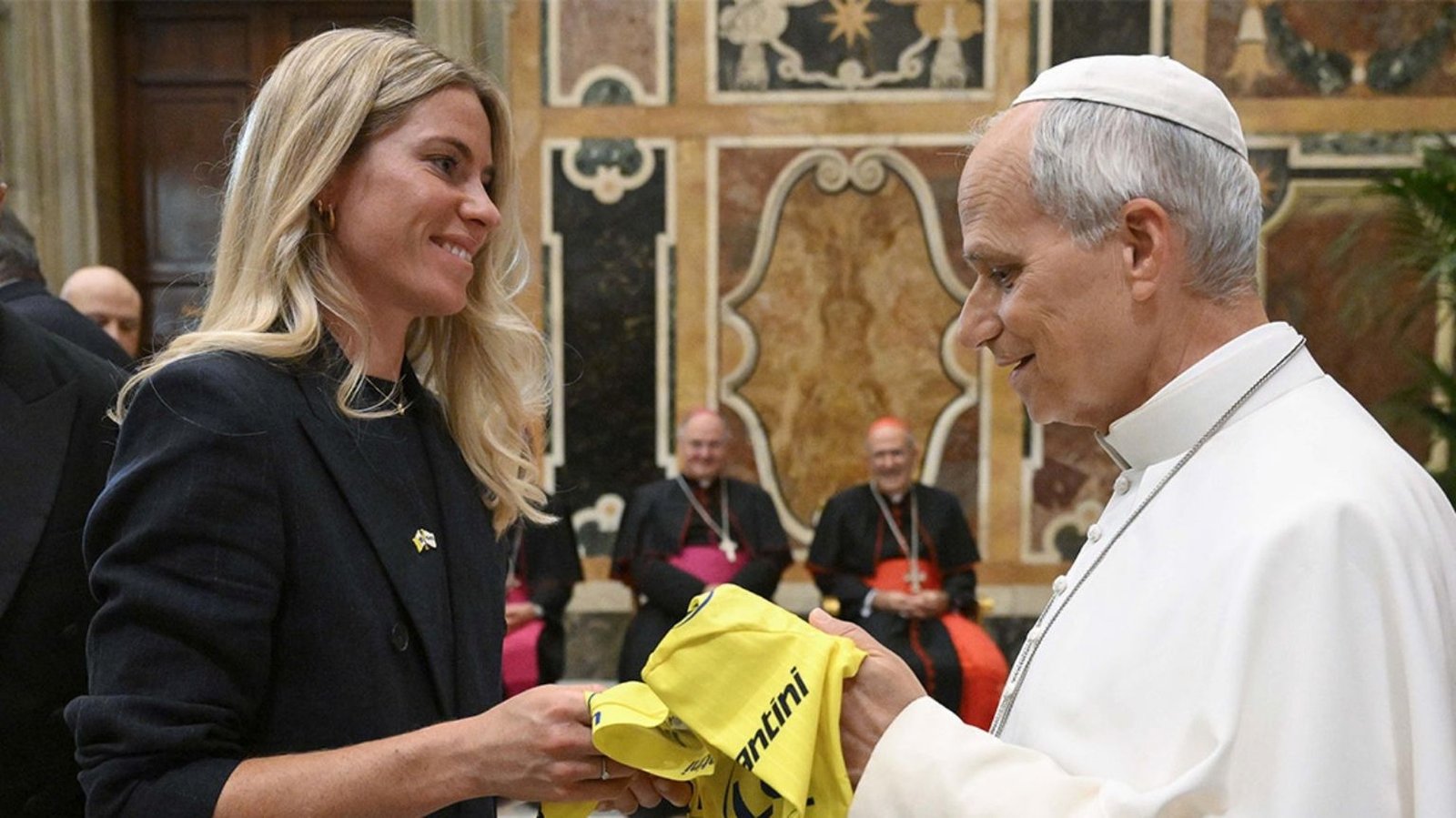
The Vatican welcomed some of the biggest names in international cycling on Monday, 23 November 2026, as Pope Leo XIV received a delegation of riders, former champions and representatives of the sport. The audience brought together around 100 distinguished guests in an event promoted by the Holy See’s Dicastery for Culture and Education in collaboration with the Union Cycliste Internationale (UCI).
The gathering was more than a meeting of famous athletes. It offered an opportunity to reflect on cycling’s cultural, human and spiritual dimensions, while highlighting the sport’s ability to connect generations and communities. The programme also included a symbolic donation of bicycles by the UCI to Caritas Rome, an initiative organised by Athletica Vaticana, the Vatican’s multi-sport association and a UCI member.
Pope Leo XIV welcomes the international cycling community
The audience took place in the Clementine Hall of the Apostolic Palace. The delegation represented several parts of the sport: men’s and women’s road cycling, para-cycling, BMX, national federations, race organisers and the organisations behind cycling’s major stage races. The Tour de France, Giro d’Italia and La Vuelta were among the Grand Tour institutions represented.
Among the celebrated names associated with the gathering were five-time Tour de France winner Eddy Merckx, five-time Tour de France champion Bernard Hinault, three-time Tour de France winner Greg LeMond, Miguel Indurain, Vincenzo Nibali, Mark Cavendish and Chris Froome. Women’s cycling was represented by champions including Demi Vollering, Annemiek van Vleuten and Jeannie Longo. The group also included current talents and athletes from disciplines beyond road racing, underlining the breadth of modern cycling.
The UCI’s announcement ahead of the event named a representative group of 100 guests. Its list included BMX Racing Olympic champion Mariana Pajón, para-cycling champion Ricardo Ten Argilés and Ukrainian rider Anna Kolyzhuk, whose recovery from a serious spinal injury has become an important part of her story. The meeting therefore recognised not only famous palmarès, but also the determination and diversity found throughout the sport.
The Pope reflects on cycling, sport and human values
In his address, Pope Leo XIV described cycling as one of the world’s most popular and beloved sports and noted that the bicycle forms part of the history and identity of many cultures. He spoke about its practical role in everyday mobility and healthy living, while also considering how cycling can create opportunities for reflection and meaningful spiritual experiences.
The Pope connected the emotional extremes of competition with wider experiences of life. Victories and defeats, joy and disappointment, he explained, reflect values and challenges that people encounter beyond sport. His message encouraged those involved in cycling to look beyond results and ensure that the sport continues to foster authentic human experiences.
He also spoke about the relationship between physical effort and the inner life. Cycling, in his view, can take people away from the noise and traffic of cities and towards places of silence and contemplation, allowing them to appreciate creation. The bicycle was presented not simply as a machine for competition or transport, but as something that can support a more attentive relationship with the world.
Our Lady of Ghisallo and cycling’s spiritual history
A notable part of the Pope’s address focused on Our Lady of Ghisallo, a Marian devotion closely associated with cycling. The sanctuary of Madonna del Ghisallo, near Magreglio in northern Italy, has long been a spiritual landmark for riders and supporters. Pope Leo recalled that Pope Pius XII proclaimed Our Lady of Ghisallo the patroness of cyclists on 13 October 1949.
The site has become known for the trophies, jerseys and other objects offered by cyclists in gratitude or in search of protection. The Pope also referred to pilgrimages that have brought cyclists to the Vatican, showing how the bicycle can become a means of community and, in some cases, evangelisation.
He recalled Blessed Giovanni Fornasini, an Italian priest and martyr who used his bicycle to travel between villages, encourage local people and bring them the sacraments. His story offered another example of cycling as a practical instrument placed at the service of others.
UCI donation of bicycles to Caritas Rome
The audience concluded with a symbolic act of solidarity. The UCI donated several bicycles to Caritas Rome, the charitable organisation serving people in need in the Italian capital. Athletica Vaticana organised the initiative, linking the Vatican’s sporting community with the UCI and a practical charitable contribution.
The gesture gave the event a concrete outcome beyond the speeches and photographs. It reflected a central theme of the meeting: sport can create connections and encourage service to others. The UCI had presented the audience as an opportunity to strengthen cycling’s contribution to peace and intercultural dialogue, and the donation provided a visible expression of that intention.
A long relationship between cycling and the Vatican
The meeting also continued a relationship that has developed over many decades. The UCI recalled earlier encounters between cycling figures and popes, including Eddy Merckx’s audience with Pope Paul VI in 1974. More recently, the Giro d’Italia passed through Vatican City during the 2025 Jubilee celebrations, creating another moment of contact between the sport and the Catholic Church.
For the Giro, the November 2026 audience added a new chapter to that connection. Representatives of the race joined a wider international group that included organisers, federations and athletes from different generations. It was a reminder that professional cycling is not only a calendar of races, teams and results, but also a global community shaped by shared history and values.
Why the Vatican audience matters for cycling
The significance of the meeting lies in the range of people it brought together and the message delivered to them. Grand Tour winners stood alongside women’s champions, para-cyclists, BMX athletes, young prospects and administrators. That mix reflected a sport whose identity extends well beyond the men’s WorldTour peloton.
The Pope’s remarks also placed responsibility on the people who shape cycling: athletes, team leaders, race organisers and governing bodies. The challenge is to protect the human values of sport, promote respect and solidarity, and remember those who have lost their lives in road accidents. Pope Leo ended by inviting those present to remember deceased cyclists in their prayers and imparted his Apostolic Blessing to the participants and their families.
For cycling, the Vatican audience was therefore both a celebration of achievement and a call to look at the wider purpose of sport. The champions in attendance represented extraordinary records and careers, but the central message was that cycling’s influence can reach further: towards community, contemplation, inclusion, peace and practical help for others.
Related SportViaX coverage
Discover more from SportViaX: read our profile of Demi Vollering and her rise in women’s cycling, explore the Giro d’Italia 2027 route and its major mountain stages, and learn how the UCI WorldTour system works.
Official sources
- The Holy See – Pope Leo XIV’s full address to the UCI and cycling representatives, 23 November 2026
- UCI – The Holy Father meets the World of Cycling, event announcement and guest list
- Giro d’Italia – Cycling’s Biggest Names Meet Pope Leo XIV