

The route for the 110th Giro d’Italia has been unveiled, and the 2027 edition is a major test for climbers and complete Grand Tour contenders. The race will run from 8 to 30 May 2027, starting and finishing in Italy for the first time in several years, with Trieste hosting the Grande Partenza and Rome staging the finish.
Across 21 stages, the peloton will cover 3,418.9 kilometres and tackle 50,250 metres of elevation gain. The route includes seven uphill finishes and two individual time trials: a 19.6km climbing test to Campo di Giove and a 37.3km flatter race against the clock from Monza to Milan. The main mountain challenges are a double ascent of the Mortirolo, the return of Passo Gavia and a summit finish on Monte Zoncolan.
Giro d’Italia 2027: route at a glance
- Dates: 8–30 May 2027
- Start: Trieste, Italy
- Finish: Rome, Italy
- Stages: 21
- Total distance: 3,418.9km
- Total elevation gain: 50,250m
- Individual time trials: 2 (19.6km and 37.3km)
- Summit finishes: 7
All 21 stages of the 2027 Giro d’Italia
The stage information below follows the route presentation published by the race organisers. Distances and the main technical features are included for every day; detailed gradients and intermediate climb profiles should be checked against the official stage maps, as not every road-sector measurement has been published in the written route summary.
Stage 1, 8 May: Trieste to Trieste (172km)
The opening stage is a rolling circuit around Trieste, with approximately 2,400m of climbing. The route briefly crosses into Slovenia and features three short climbs in the final 40km. This terrain could favour punchy riders and fast finishers who can handle repeated accelerations. The first pink jersey may therefore be decided by a reduced group rather than a conventional bunch sprint.
Stage 2, 9 May: Ljubljana to Koper (166km)
The second stage stays entirely in Slovenia. Its approximately 2,200m of elevation gain comes from repeated rolling roads between the capital and the Adriatic coast. The profile offers opportunities for breakaway riders and resilient sprinters, while the final approach to Koper could produce another tactical finish.
Stage 3, 10 May: Cervignano del Friuli to Possagno (163km)
The race returns to Italy for a stage with around 1,450m of climbing. The route is mostly manageable but includes the Montello and Mostaccin undulations, which could disrupt the sprint teams and encourage late attacks. Possagno sits at the foot of Monte Grappa, making this a potentially selective finish in the Veneto region.
Stage 4, 11 May: Argenta to Misano Adriatico (151km)
This is one of the clearest sprint opportunities of the opening week. The route across Emilia-Romagna is predominantly flat, with no major climbing obstacle expected to prevent the fast teams from organising a bunch finish. The stage ends at the Autodromo Marco Simoncelli, bringing the Giro to the famous motorsport venue near the Adriatic coast.
Stage 5, 12 May: Filottrano to Sarnano-Sassotetto (139km)
The first summit finish arrives after only 139km, but the stage packs in approximately 3,300m of elevation gain. The decisive ascent to Sassotetto in the Sibillini Mountains is reported at 13.1km with an average gradient of 7.4%. It is an early general-classification test that should reveal which contenders have arrived in good climbing condition. The start in Filottrano also pays tribute to Michele Scarponi, ten years after his death.
Stage 6, 13 May: Alba Adriatica to Lanciano (148km)
The Abruzzo stage follows an undulating route from the Adriatic coast into the inland terrain. Repeated climbs and descents make it harder to control than a flat sprint stage, and the uphill approach to Lanciano could suit an explosive attacker or a breakaway group. The main GC contenders will need to stay alert on the rolling roads.
Stage 7, 14 May: Sulmona to Campo di Giove (19.6km individual time trial)
The first time trial is a climbing test rather than a flat specialist course. Riders will cover 19.6km, with the second part rising towards Campo di Giove at gradients around 5%. Pacing, aerodynamic positioning and the ability to sustain power uphill will all matter. This stage could create meaningful gaps between climbers and riders who are less comfortable against the clock. Read our guide to how time trials work in professional cycling.
Stage 8, 15 May: Trasacco to Naples (219km)
At 219km, this is one of the longest stages of the race. The peloton travels from Abruzzo towards Campania, crossing the Apennines before reaching Naples for the sixth consecutive Giro edition. Although the finish city has often produced sprint battles, the route profile includes several short rises in the final 30km, potentially opening the door to punchy riders and late moves.
Stage 9, 16 May: Itri to Subiaco–Monte Livata (180km)
The first week ends with a mountain stage in Lazio and a summit finish at Monte Livata. After a relatively flat opening of around 70km, the route becomes more demanding before the final climb, which measures 13.9km at an average gradient of 6.9%. The steepest gradients are concentrated in the opening four kilometres of the ascent. This is a significant opportunity for climbers to attack before the first rest day.
Stage 10, 18 May: Palombara Sabina to Norcia (218km)
After the rest day, the Giro resumes with a long 218km Apennine stage and approximately 3,600m of elevation gain. The constantly rolling profile includes the Forca di Presta and Forca Ventolosa climbs around the Castelluccio area. There is little room for a prolonged recovery, making this a day for riders who can manage repeated changes of pace and teams capable of controlling a long breakaway.
Stage 11, 19 May: Gualdo Tadino to Scarperia (220km)
The longest stage of the 2027 Giro covers 220km through the Umbrian and Tuscan Apennines. Climbs and descents in the middle section will test the peloton, but the finish at the Mugello Circuit could give the sprinters another opportunity if the race comes back together. The distance and terrain may also make a successful breakaway difficult to control.
Stage 12, 20 May: Montecatini Terme to Zeri, Passo Due Santi (173km)
The Tappa Bartali introduces an uphill finish at Passo Due Santi in the Zeri area, a climb not previously used by the Giro. The route becomes increasingly demanding in its second half, with much of the elevation concentrated before the finish. Its unfamiliar final ascent could reward riders who have studied the climb and can judge their effort without extensive race-day references.
Stage 13, 21 May: Borgo Val di Taro to Reggio Emilia (176km)
The route leaves the Parma Apennines and gradually descends towards the Po Valley. After easier climbing early in the stage, the roads become more straightforward, giving sprint teams a chance to organise a chase. Reggio Emilia is therefore a likely destination for a bunch sprint, although a well-timed breakaway could still take advantage of the transition from hills to flat terrain.
Stage 14, 22 May: Cantù Arena to Piani di Bobbio/Valtorta (187km)
This major mountain stage carries approximately 4,900m of elevation gain. The route crosses the Ghisallo, Culmine di San Pietro, Miragolo San Salvatore and Alino climbs before the uphill finish at Piani di Bobbio. The repeated ascents will place a heavy demand on domestiques and climbing teams, while the final climb offers a clear opportunity for GC contenders to attack before the second time trial.
Stage 15, 23 May: Monza to Milan (37.3km individual time trial)
The second time trial is a 37.3km test beginning inside the Autodromo Nazionale di Monza and finishing in Milan. Unlike the uphill test in week one, this course is predominantly flat and fast, favouring riders who can sustain high speed and hold an aerodynamic position. It is a major opportunity for time-trial specialists to gain time on climbers before the decisive final week.
Stage 16, 25 May: Sondrio to Aprica (192km)
This is the queen stage on paper: 192km with approximately 5,700m of climbing. The route features two ascents of the Mortirolo, designated the Montagna Pantani, with the Passo Gavia (the Cima Coppi, or highest point of the race) between them. The sequence of Mortirolo, Gavia and a second Mortirolo ascent is a severe test of endurance. With the finish in Aprica, this stage could reshape the general classification and decide which riders remain realistic contenders for the pink jersey.
Stage 17, 26 May: Chiari to Vo’ (194km)
After the Alpine stage, the peloton faces 194km from Lombardy into Veneto. The opening section is relatively flat, but the finale becomes more selective around the Colli Euganei, with several short, steep local climbs known as muri. This stage could suit a breakaway or riders with an explosive finish, while tired GC teams will need to manage the transition carefully.
Stage 18, 27 May: Rovereto to Madonna di Campiglio (154km)
The Giro returns to the mountains of Trentino for a 154km stage finishing at Madonna di Campiglio. The route includes a circuit of roughly 50km between Ponte Arche and Spiazzo, taking in two ascents of Passo Durone and the Passo Daone before the final climb. The rising difficulty and summit finish make this another important day for the overall contenders, particularly after the previous Alpine test.
Stage 19, 28 May: Rovereto to Sacile (199km)
The 199km stage begins with the climbs of Vigolo Vattaro and Bieno before a long predominantly descending and flatter section. Late rises at Montaner and Castello di Caneva add tactical difficulty before the finish in Sacile. This could be a day for attackers and breakaway specialists, especially with the final mountain stage approaching.
Stage 20, 29 May: Pordenone to Monte Zoncolan (180km)
The final mountain stage ends on one of Italy’s most feared climbs. Before reaching the Zoncolan, riders face Passo Duron (1,069m) and Sella Valcalda (958m). The decisive ascent from Ovaro measures 10.1km at an average gradient of 11.9%, with ramps reaching 22%. Monte Zoncolan returns to the Giro after its 2018 edition, when Chris Froome won on the same side. With only one stage remaining, this is likely to be the last major opportunity to change the overall standings.
Stage 21, 30 May: Rome to Rome (131km)
The traditional final day is a flat 131km circuit in the Italian capital. The city route includes a circuit of approximately 9km to be completed eight times, creating a familiar setting for the final sprint and the presentation of the Trofeo Senza Fine. The final stage is expected to confirm the overall winner rather than decide the race.
Giro d’Italia 2027 Plan All stages
The three climbs that could define the Giro
Mortirolo: a double test on the queen stage
The Mortirolo will be climbed twice on Stage 16, giving it a central role in the most demanding day of the race. Its repeated inclusion means the contenders must manage their effort across a long sequence of climbs rather than rely on one isolated attack. The organisers have designated it the Montagna Pantani, underlining its place in Giro history.
Passo Gavia: the Cima Coppi returns
Passo Gavia returns to the Giro for the first time since 2014 and will be the Cima Coppi in 2027, meaning the highest point of the race. Its position between the two Mortirolo ascents makes the stage especially demanding: riders must negotiate the high mountain pass before facing another major climb on the way to Aprica. Weather and road conditions at altitude may also be important factors, subject to conditions on race day.
Monte Zoncolan: the last summit finish
The Ovaro side of Monte Zoncolan is among the most feared climbs in professional cycling. Its 10.1km length, 11.9% average gradient and maximum ramps of 22% make it a severe final-week test. The climb is scheduled to host the Giro finish for the first time since 2018, when Chris Froome won from the Ovaro side.
Which riders the route favours
The route appears to favour a versatile climber who can also limit losses in a long flat time trial. The 19.6km uphill time trial gives climbing specialists a chance to gain time, while the 37.3km Monza–Milan test could benefit powerful riders with strong aerodynamic positions. Seven uphill finishes and a demanding final week mean that recovery, team support and consistency will be just as important as explosive climbing ability.
For more background on the riders who could target a Grand Tour, read our coverage of Jonas Vingegaard’s career and 2026 season and Tadej Pogačar’s possible 2027 race programme. You can also explore our report on the proposed gravel changes to the Angliru.
Official route, sources and image credits
For the complete official stage maps, elevation profiles and organiser updates, visit the Giro d’Italia 2027 route announcement and the official 2027 route and stage profiles. Additional route analysis: Cyclingnews: complete guide to all 21 stages.
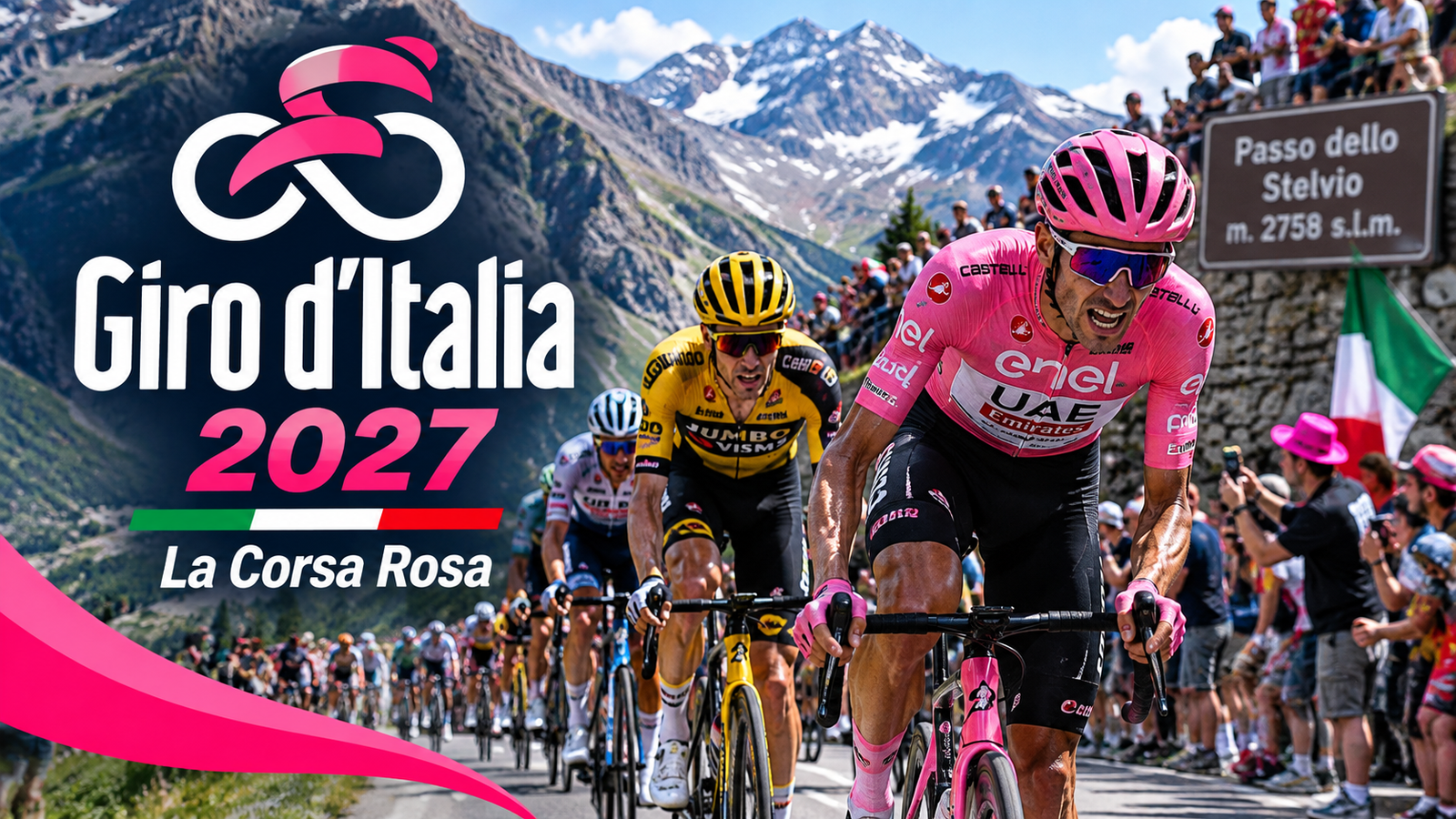
AI-generated image note: Created for SportViaX. This is an AI-generated illustrative image and is not an official photograph from the race or its organisers.
Featured image: Passo del Gavia. Photo by Gabri80 (Italian Wikipedia), released into the public domain. Source and licensing information: Wikimedia Commons: Passo del Gavia. The image is used here as a landscape illustration; it is not presented as an official 2027 race photograph.
Editorial note: Stage distances and route features are based on the organisers’ route presentation published on 3 November 2026. Road conditions, weather, exact race timings and any subsequent route amendments may change before the event.